Your Business Ranks on Google, But Does ChatGPT Recommend You?
For years, businesses have focused on one main goal: ranking higher on Google.
They invest heavily in SEO, build backlinks, publish blog posts, optimize their websites, and compete for the top positions in traditional search engine results pages.
But search behavior is changing rapidly.
People are increasingly asking AI assistants questions like:
“What's the best web design agency near me?”
“Recommend a reliable accountant for my startup.”
“Which marketing agency specializes in SaaS?”
“What are the best alternatives to this software?”
Instead of browsing ten different websites, users can now receive direct recommendations from ChatGPT, Gemini, Claude, and Perplexity.
This creates a new challenge for businesses: being visible in search results doesn't necessarily mean being recommended by AI.
Traditional SEO vs. AI Search Visibility
Traditional SEO focuses on helping your website rank for relevant keywords in search engines.
AI search visibility focuses on whether AI-powered systems mention your business, recommend your services, or cite your website when answering relevant questions.
These two areas overlap, but they aren't identical.
A business might rank well for a specific keyword on Google while remaining absent from AI-generated answers. Another business might get mentioned because its website, reviews, directory listings, and other online sources provide useful information.
AI recommendations vary by platform, query, location, and time. There is no single ranking position that guarantees your business will appear in every AI answer.
That's why businesses need to understand both their traditional search performance and their visibility across AI-powered discovery platforms.
5 Ways to Improve Your Business's AI Visibility
Here are five practical ways to optimize your brand so AI assistants cite and recommend your business to prospective clients:
1. Make Your Website Easy to Understand
Your website should clearly explain what your business does, who it serves, where it operates, and what makes it different.
Avoid vague descriptions that could apply to any company. For example, instead of saying “We provide innovative digital solutions,” explain the specific services you offer, the customers you help, and the problems you solve.
Clear, useful information makes your business easier for people and search systems to understand.
2. Build a Consistent Online Presence
Your website is only one part of your digital footprint.
Business directories, professional profiles, industry publications, review platforms, and relevant third-party websites can all help people discover and verify your business.
Keep your business name, contact information, services, and other important details consistent across these sources.
Focus on relevant, trustworthy platforms rather than submitting your business to hundreds of low-quality directories.
3. Publish Content That Answers Real Questions
Think about the questions potential customers ask before choosing a business.
Create useful pages that answer those questions directly. Include practical examples, comparisons, pricing information where appropriate, and explanations of your process.
For example, a local accounting firm could publish articles about tax filing requirements, accounting software comparisons, and common bookkeeping mistakes.
The goal isn't to mention your business in every paragraph. It's to become a genuinely useful source of information in your field.
4. Monitor Your Competitors
Search for the questions your customers are likely to ask AI assistants.
Notice which businesses appear in the answers, what sources are cited, and which competitors repeatedly receive recommendations.
This can reveal opportunities you may have overlooked, such as missing service pages, incomplete directory profiles, or topics that deserve better coverage on your website.
Remember that AI answers can change between queries, so check multiple relevant questions and repeat your analysis over time.
5. Measure AI Visibility Instead of Guessing
Manually testing prompts in different AI tools can help you understand your current visibility, but doing it consistently across many questions and competitors becomes time-consuming.
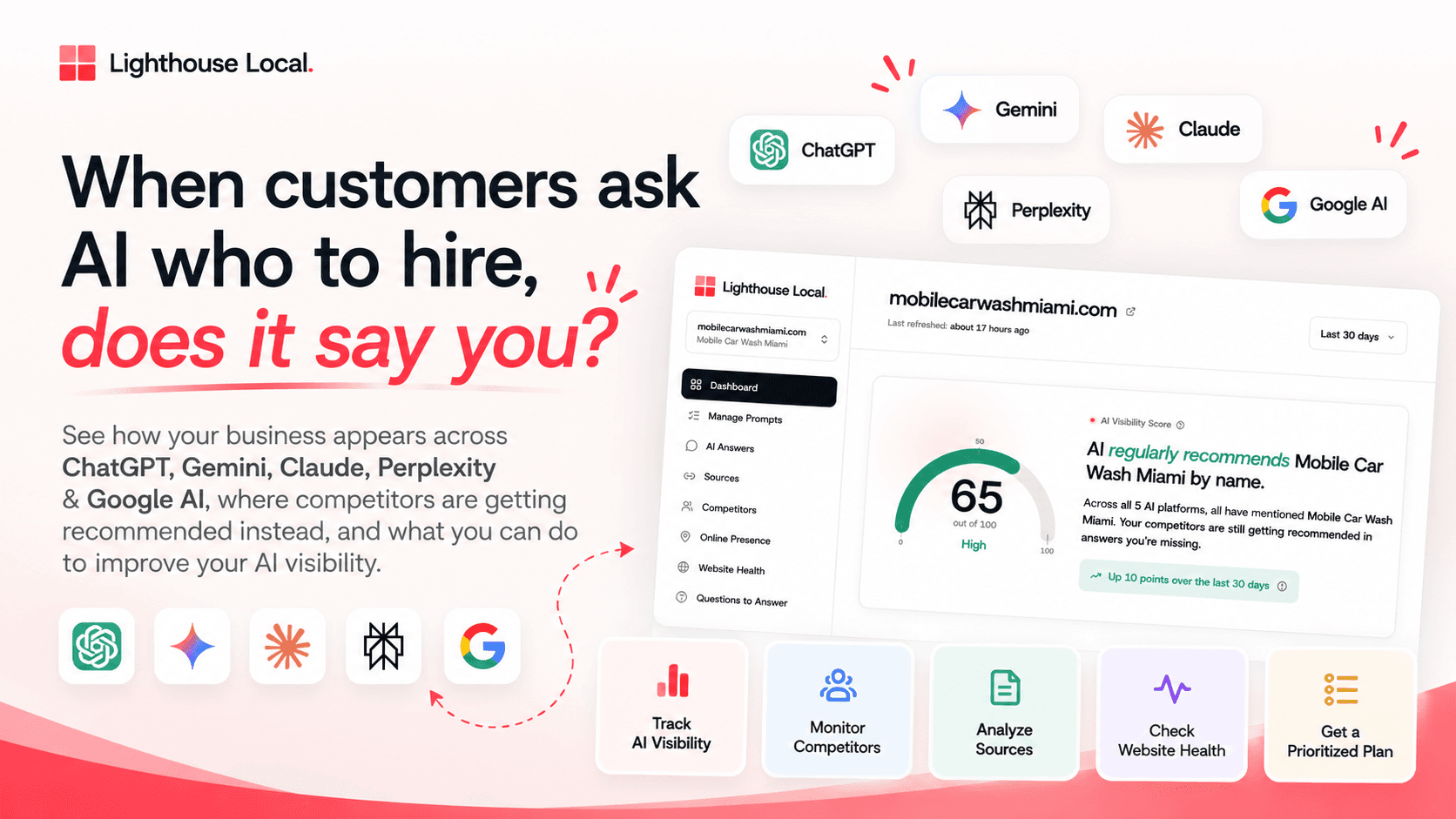
This is where dedicated monitoring tools can help. For example, Lighthouse Local helps businesses track their visibility across ChatGPT, Gemini, Claude, Perplexity, and Google AI. It also identifies competitors being recommended, analyzes sources behind AI answers, and provides a prioritized plan for improving visibility.
Rather than relying on a few isolated searches, businesses can use this type of analysis to identify patterns and decide what to improve next.
What Should You Track?
If you're serious about improving your presence in AI-powered search, start with a small set of measurable indicators:
No single metric tells the whole story. A visibility score is useful for tracking progress, but it shouldn't be confused with guaranteed traffic, leads, or revenue.
Is AI SEO Replacing Traditional SEO?
No. Traditional SEO remains important.
Search engines still help people discover websites, compare services, and find answers. At the same time, AI assistants introduce additional ways for potential customers to discover businesses.
The more practical approach is to strengthen your overall online presence while adapting your strategy to these emerging discovery channels.
That means maintaining a technically sound website, publishing useful content, building a credible online reputation, and understanding how your business appears across different search experiences.
Businesses that start measuring these changes now may be better positioned to identify opportunities as customer behavior evolves.
The Complementary Future of Search
Final Thoughts
Your next customer might not search Google for the best business in your category. They might ask an AI assistant for a recommendation instead.
The important question is whether your business appears in those conversations, what information supports the recommendation, and which competitors are getting noticed instead.
You can start by manually testing relevant prompts across AI platforms and documenting the results. As your monitoring needs grow, tools such as Lighthouse Local can help you track AI visibility, analyze competitors and citations, and turn the findings into actionable improvements.
Don't abandon SEO. Expand your understanding of where your customers discover businesses.