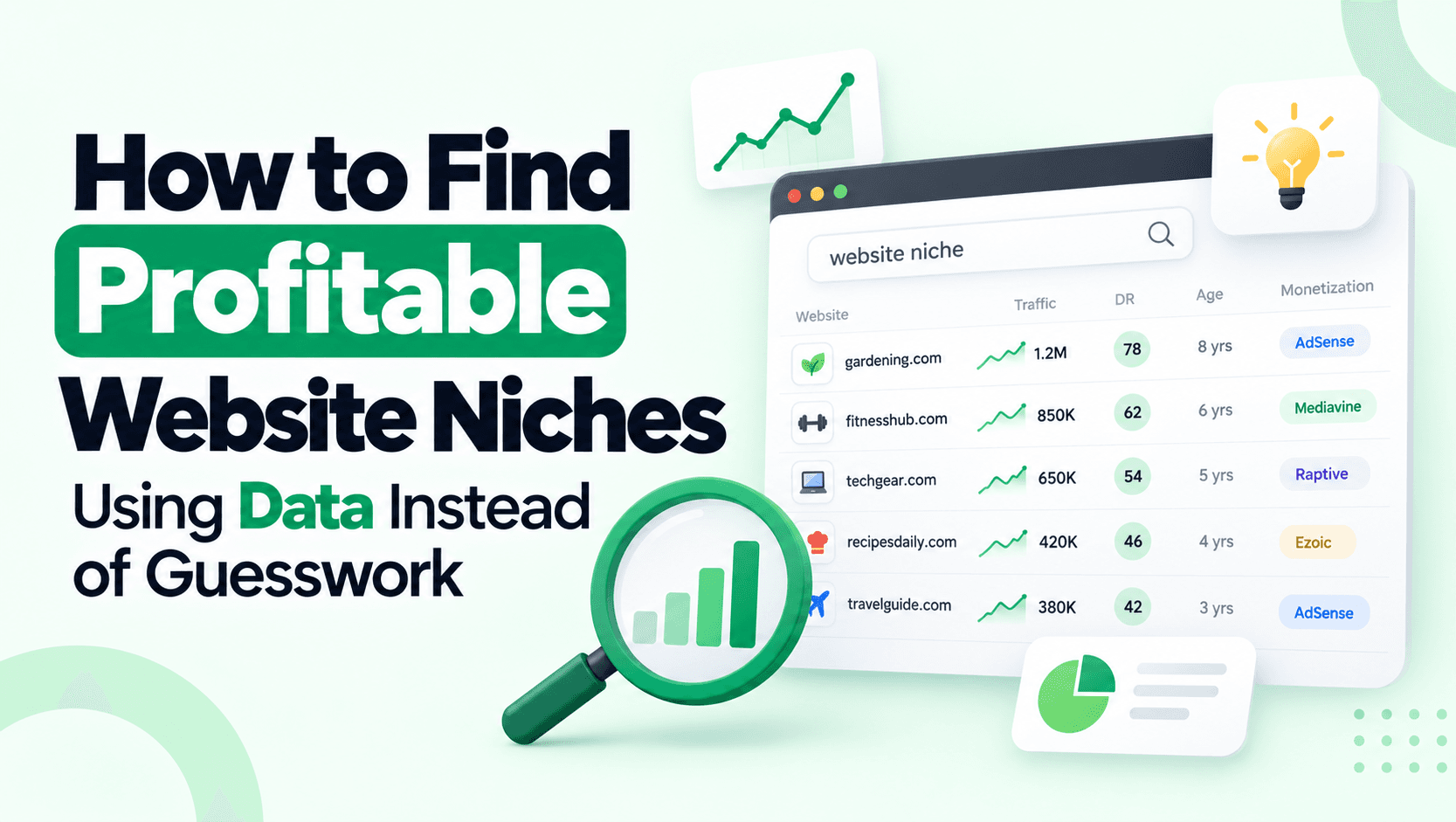
How to Find Profitable Website Niches Using Data Instead of Guesswork
Building a successful website starts long before you publish your first article. One of the most important decisions is choosing the right niche.
Many entrepreneurs begin with keyword research, trending topics, or ideas they believe could attract traffic. While these methods can help, they don't always reveal the full competitive landscape or whether existing websites show signs of monetization.
A more informed approach is to study websites that already operate in your target market.
By analyzing estimated traffic, domain strength, website age, and monetization signals, you can discover potential opportunities and decide which niches deserve further research.
Why Website Niche Research Matters
Choosing a niche requires more than finding keywords with high search volume.
You also need to understand the websites competing for that audience, the content they publish, and the strategies they use to attract visitors.
For example, a niche may have thousands of monthly searches but be dominated by established publishers with extensive backlink profiles. Another niche may have a smaller audience but contain more focused topics that are worth investigating.
Neither situation guarantees success. However, examining existing websites can help you make more informed decisions before committing months of work.
What Should You Analyze Before Choosing a Niche?
Here are several useful data points to consider when researching website opportunities.
1. Estimated Website Traffic
Traffic estimates can help you identify websites that appear to attract an established audience. Compare multiple websites rather than relying on a single successful example.
Investigate their important pages, content categories, and potential traffic sources to understand what might be working.
2. Domain Rating and Backlinks
Domain Rating (DR), a metric developed by Ahrefs, measures the relative strength of a website's backlink profile.
Although DR is not a Google ranking factor, it can help you compare competing websites and investigate how their backlink profiles differ.
A lower-DR website attracting estimated traffic may be worth studying, but this doesn't automatically mean its niche is easy to enter.
3. Website Age
Website age provides additional context when comparing competitors. Older websites may have had more time to build authority and publish content, while newer websites can reveal emerging approaches or opportunities.
Use age alongside other metrics rather than treating it as a predictor of success.
4. Advertising Monetization Signals
Some websites are associated with advertising networks such as Google AdSense, Ezoic, Mediavine, and Raptive.
These signals can help you identify websites using advertising-based monetization. However, network participation does not reveal exact earnings or guarantee profitability.
Discover Website Opportunities With Niche Pickers
Collecting these metrics manually across hundreds of websites can be time-consuming.
Niche Pickers - Find Money Making Niches Instantly is an SEO research platform designed to help entrepreneurs, publishers, affiliate marketers, and niche site builders discover websites worth investigating.
Its searchable database contains more than 386,000 websites checked against advertising network records from AdSense, Ezoic, Mediavine, and Raptive.
Users can filter websites by:
Database Backed by Similarweb & Ahrefs
These features help streamline initial research by allowing users to narrow down websites based on specific criteria instead of manually compiling every data point.
A Practical Workflow for Finding Your Next Niche
You can use the following process to turn website research into a more structured SEO strategy.
Step 1: Choose a market
Start with a subject you understand or can realistically research, such as technology, education, personal finance, or hobbies.
Step 2: Find existing websites
Identify several websites operating in that market and compare their estimated traffic, domain strength, and content focus.
Step 3: Look for patterns
Investigate whether smaller websites attract meaningful estimated traffic and which topics appear to be central to their content strategies.
Step 4: Validate keyword opportunities
Use SEO tools to evaluate search demand, keyword difficulty, and search intent. Don't assume all estimated traffic comes from organic search.
Step 5: Identify a gap
Look for underserved audiences, outdated resources, or topics where you could create something more useful or differentiated.
Step 6: Build a realistic plan
Consider your expertise, available resources, publishing schedule, and potential monetization model before committing heavily.
Accelerate Your Validation Process
Common Mistakes to Avoid
Website research is useful, but several mistakes can lead to poor decisions.
The purpose of research is to reduce avoidable guesswork, not eliminate uncertainty.
Final Thoughts
Choosing a website niche is a long-term decision. Before investing time and resources into content creation, study the websites already serving your target audience.
Analyze their estimated traffic, backlink profiles, content strategies, and monetization signals. Then combine those insights with keyword research and a clear understanding of what you can offer.
No database can guarantee that a niche will succeed, but better research can help you evaluate opportunities more systematically.
If you're planning your next SEO project, explore Niche Pickers - Find Money Making Niches Instantly to discover websites worth studying before you build.
The goal isn't to copy what's already working. It's to understand the market well enough to find your own opportunity.